FAQ / BPC-157 RESEARCH RECORD
Common questions on the research, regulatory, and mechanistic record.
Answers drawn from the published literature. No medical advice. No dosing recommendations.
Compound and mechanism
Q: What is BPC-157 and where does it come from?
BPC-157 is a pentadecapeptide — a chain of exactly 15 amino acids — with the sequence Gly-Glu-Pro-Pro-Pro-Gly-Lys-Pro-Ala-Asp-Asp-Ala-Gly-Leu-Val and a molecular weight of 1419.5 Da. It was isolated as a partial sequence of a protective protein found in human gastric juice. 'Body Protection Compound 157' is the research designation; it has also been studied as PL 14736, PL-10, and PLD-116. Its gastric origin accounts for its documented stability in acidic conditions and the oral bioavailability observed in rodent studies.
Q: How does BPC-157 work at the molecular level?
The published research identifies several signaling mechanisms. The most extensively studied is activation of the VEGFR2-Akt-eNOS axis, which promotes angiogenesis (new blood vessel formation) in injured tissue [1]. A second mechanism is modulation of the Src-Caveolin-1-eNOS pathway in vascular endothelial cells, producing endothelium-dependent vasorelaxation [2]. Additional studied mechanisms include ERK1/2 proliferation signaling, FAK-paxillin fibroblast signaling, NF-kB suppression (anti-inflammatory), HO-1 and heat shock protein cytoprotection, macrophage M1-to-M2 phenotype shift, growth hormone receptor upregulation in tendon fibroblasts [5], and context-dependent normalization of the nitric oxide system across all three NOS isoforms (Nos1, Nos2, Nos3) [14]. A single compound activating this range of signaling pathways is unusual; the review literature characterizes it as pleiotropic.
Q: What does the research say about BPC-157 and tissue repair?
The tissue repair evidence base is the largest cluster in the published record. Key findings include: superior Achilles tendon load-to-failure and collagen organization in rat transection models at 10 μg/kg IP [3]; enhanced tendon fibroblast migration and oxidative stress protection in vitro [4]; sevenfold GHR upregulation in tendon fibroblasts [5]; complete walking-pattern recovery in quadriceps detachment models [6][17]; normalized creatine kinase and LDH following muscle crush [7]; and wound healing superior to PDGF-BB in diabetic wound models [8]. These findings are in rodent models. The 2025 McGuire et al. review characterized the preclinical musculoskeletal evidence as strong while noting the absence of any randomized human trial [16].
Q: Is BPC-157's effect on angiogenesis a risk for people with cancer?
This question appears in the published review literature. The 2025 McGuire et al. review notes that VEGFR2 upregulation could theoretically promote pathological angiogenesis in pre-existing tumor microenvironments. However, in vitro data suggests BPC-157 inhibits rather than promotes uncontrolled cell proliferation [16]. The context-dependent nature of its angiogenesis modulation — promoting healing angiogenesis in injured tissue while inhibiting pathological neovascularization in the cornea [14] — complicates straightforward risk extrapolation. This remains an unresolved question in the absence of human oncology-context data.
Regulatory and legal status
Q: Is BPC-157 legal in the United States?
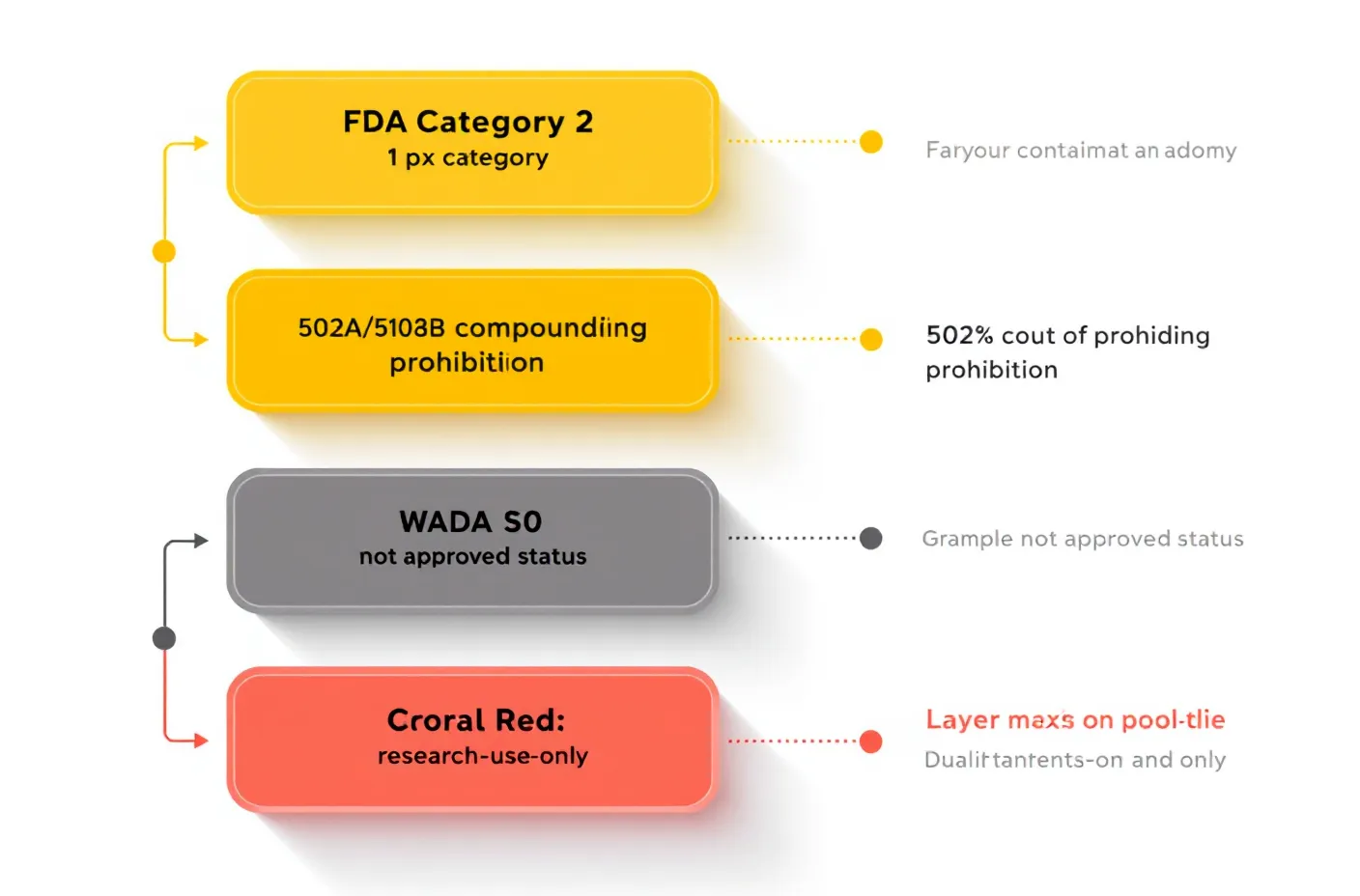
BPC-157 is not a scheduled controlled substance. Possession is not criminalized under the Controlled Substances Act. FDA now places BPC-157 in its 'Bulk drug substances nominated but withdrawn' table, where its safety concerns remain visible FDA. The withdrawn nomination is not a favorable compounding decision or drug approval.
Q: How does FDA describe the withdrawn BPC-157 nomination?
FDA's safety notice identifies insufficient human safety information, possible immunogenicity, and impurity concerns beside the withdrawn BPC-157 nomination. BPC-157 has no FDA-approved human indication, and a withdrawn nomination is not an entry on the final 503A Bulks List. BPC-157 acetate and BPC-157 free base went before the FDA Pharmacy Compounding Advisory Committee at its July 2026 meeting, where FDA staff had proposed against listing them; FDA has not published the committee's votes, so any effect on the regulatory landscape is still unknown.
Q: Can BPC-157 be prescribed by a doctor?
Prescribing BPC-157 requires a licensed clinician to assess the individual patient and decide whether a prescription is appropriate; a request can be declined. The patient's U.S. state and the treatment being considered both constrain access. Compounded BPC-157 has no FDA approval. There is no FDA-approved BPC-157 drug product that could be prescribed from a commercial manufacturer. No active IND exists in the United States as of 2026. The compound is available through unregulated online sources of unknown purity, but sourcing through those channels does not constitute a prescription.
Q: Is BPC-157 on the WADA prohibited substances list?
Yes. WADA listed BPC-157 under S0 — Non-Approved Substances — effective 2022. The S0 category covers pharmacological substances not approved by any governmental regulatory health authority for human therapeutic use. Any competitive athlete subject to anti-doping testing who uses BPC-157 is at risk of a positive anti-doping result.
Q: What is the difference between IRB-supervised research and clinical prescribing of BPC-157?
IRB-supervised research involves ethical oversight by an Institutional Review Board, documented informed consent from participants, a defined research protocol, and monitoring for adverse events. The three published human BPC-157 studies were conducted under IRB approval or equivalent ethics oversight. An individual prescription and the applicable pharmacy rules govern clinical compounding; IRB approval governs research participation. Those are separate forms of oversight, and neither establishes an FDA-approved BPC-157 indication. The withdrawal of a bulks-list nomination cannot substitute for either form of oversight.
Human data and safety
Q: What human clinical data exists for BPC-157?
Three published human pilot studies: (1) a retrospective knee pain case series — n=16, 87.5% significant pain relief via intra-articular injection; (2) an intravesicular pilot for refractory interstitial cystitis — n=12 women, 80–100% symptom resolution at 6 weeks with no adverse events [18]; (3) an IV pharmacokinetic safety pilot — n=2 healthy adults, no adverse events, normal labs, plasma cleared to baseline within 24 hours [19]. Combined n=30. No randomized controlled trials. No Phase 1 dose-escalation data (NCT02637284 was cancelled in 2016).
Q: What are the known risks and limitations of BPC-157 research?
Several limitations are documented in the peer-reviewed literature: (1) more than 95% of the research is in rodent models; dose extrapolation to humans is speculative without validated human PK data; (2) the publication landscape is dominated by a single Croatian research group (Sikiric et al., University of Zagreb), raising the possibility of publication bias — independent replication is limited; (3) the very short plasma half-life (<30 minutes) complicates standard PK modeling; (4) no standardized formulation or purity specification exists for research-grade BPC-157; (5) theoretical immunogenicity concerns, cited by FDA when BPC-157 was placed in Category 2 and still displayed after withdrawal of its nomination, have not been addressed in human studies.
Q: What is BPC-157's estimated plasma half-life?
McGuire et al. (2025) estimated <30 minutes based on the preclinical literature [16]. The Lee & Burgess (2025) IV pilot in two humans found plasma levels returned to baseline within 24 hours following infusion, which is consistent with a short half-life [19]. A precise half-life determination in humans would require a properly powered PK study that has not been conducted.
Q: What does the research-use label mean in practice?
For BPC-157, the research-use label identifies material sold for laboratory work, rather than medication dispensed against a patient prescription. Possession for personal use is not criminalized; sale by vendors without FDA oversight occurs through channels that operate outside the approved pharmaceutical supply chain. That label is not a legal shield or evidence of FDA approval.
Q: What is the IBD trial history for BPC-157?
BPC-157 was tested under the designation PL14736 in a Phase 2 trial for ulcerative colitis, conducted in Croatia. A topical rectal formulation was used. Results have never been published in a peer-reviewed journal. The compound was also described as safe in the Klicek et al. (2008) publication on fistula healing, citing that trial [20]. A Phase 1 registration at ClinicalTrials.gov (NCT02637284, 42 healthy volunteers) was listed as cancelled in 2016 with no published results. No completed clinical trial data for BPC-157 exists in the public peer-reviewed record.
Q: What glossary terms are essential for reading the research literature?
Key terms used throughout the BPC-157 literature:
- Angiogenesis: Formation of new blood vessels from pre-existing vasculature. BPC-157 promotes this in injured tissue and inhibits pathological vessel growth in sites like the cornea [14].
- VEGFR2: Vascular Endothelial Growth Factor Receptor 2. Activation drives Akt-eNOS signaling and new vessel formation [1].
- eNOS: Endothelial Nitric Oxide Synthase. Produces nitric oxide in vascular endothelial cells; central to BPC-157's vasomotor and repair effects [2].
- Cytoprotection: Protection of cells from injury or death. BPC-157 shows cytoprotective properties in gastric, cardiac, hepatic, renal, and neuronal tissues [9][10][11].
- Myotendinous junction: Interface where muscle fiber meets tendon, studied in BPC-157 reattachment research [6][17].
- 503A / 503B: U.S. frameworks for patient-specific compounding and outsourcing facilities. BPC-157's withdrawn nomination does not by itself authorize either type of facility to compound it.
- IRB: Institutional Review Board — independent ethics oversight required for human-subject research with unapproved compounds.
- WADA S0: Category covering non-approved pharmacological substances on the WADA Prohibited List. BPC-157 was placed here in 2022.