ABOUT / BPC-157 TELEHEALTH / EDITORIAL ENTITY
An independent research record — not a clinic, not a protocol provider.
BPC-157 Telehealth is a documentation file on the published record. What it is and is not are stated plainly below.
Publisher entity
BPC-157 Telehealth is a standing file on the peer-reviewed record for Body Protection Compound 157 (pentadecapeptide BPC 157), maintained as documentation rather than as a service. It operates no clinic, retains no clinicians, and issues no medical advice. It builds nothing, sells nothing, and ships nothing. What it keeps is a sourced summary of the published science, each figure traceable to the study that reported it.
The site name incorporates the term 'telehealth' as editorial framing — a reference to the regulatory and research-infrastructure context in which BPC-157's status is actively debated: FDA's withdrawn BPC-157 nomination and retained safety concerns, WADA S0 classification, IRB-supervised research protocols, and the distinction between a clinical prescription and a research protocol administered under institutional oversight. This is a domain of active regulatory and scientific discussion. The site documents that discussion. It does not occupy any position in it as a provider, broker, or referral service.
No person affiliated with this site is a clinician. No person affiliated with this site is identified as a real individual on any page of this site. No physical address, phone number, or clinic location is associated with this site. No consultation, treatment, or prescription service is offered or implied.
Editorial standards and sourcing methodology
All factual claims on this site are sourced to peer-reviewed publications indexed in PubMed, PMC, ClinicalTrials.gov, or equivalent primary sources. DOI and PMID identifiers are provided for each citation. Citations are numbered in sequence across the site; the same number always references the same source.
The site covers the published BPC-157 research record as it exists. Where the evidence base is small (three published human pilot studies, combined n=30), that limitation is stated explicitly. Where the dominant publication source is a single research group (Sikiric et al., University of Zagreb), that concentration is noted. Where key data is missing — unpublished Phase 2 results, cancelled Phase 1 registration, no randomized controlled trials — those gaps are documented rather than papered over.
Quantitative claims (dose values, half-life estimates, study counts, effect sizes, p-values) are sourced to specific studies. Every cited figure is traceable to a publication in the references index. No figures are synthesized, averaged across studies without acknowledgment, or presented without a source.
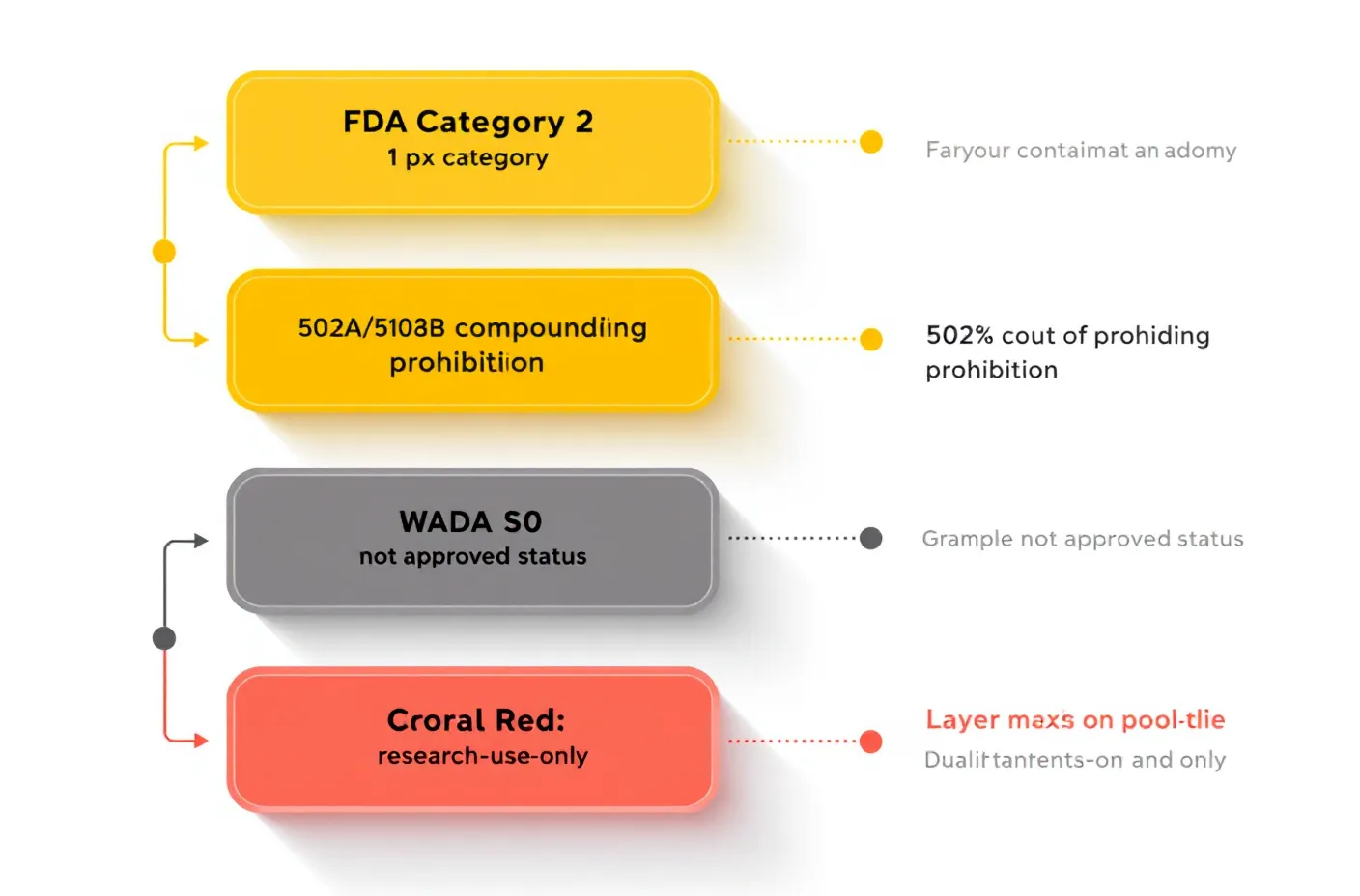
Regulatory framing. The regulatory section distinguishes the withdrawn BPC-157 nomination from FDA drug approval and from authorization to compound; WADA S0 (effective 2022), the absence of an active IND, and the lack of an FDA-approved indication remain separate parts of the record. BPC-157 acetate and BPC-157 free base were on the FDA Pharmacy Compounding Advisory Committee's July 2026 agenda for the 503A Bulks List, and FDA has published no vote record since; this development is noted on relevant pages. Any later FDA decision would need its own primary-source record.
Editorial frame. This site is a documentation file on the peer-reviewed BPC-157 literature, organized by mechanistic pathway. It is not a clinic, not a prescribing service, and not affiliated with any manufacturer or vendor. Nothing on this site constitutes medical advice.

Regulatory timeline
The following chronology documents the key regulatory events in the BPC-157 record:
- Pre-2016: BPC-157 (as PL14736) completes a Phase 2 trial for ulcerative colitis in Croatia; results never published in a peer-reviewed journal.
- 2016: ClinicalTrials.gov registration NCT02637284 (Phase 1, 42 healthy volunteers) is listed as cancelled; no results published.
- 2022: WADA places BPC-157 on the Prohibited List under S0 — Non-Approved Substances.
- FDA nomination: FDA previously placed BPC-157 in Category 2; its nomination now appears as withdrawn, with the safety concerns still published and no compounding authorization created by the withdrawal FDA.
- 2024: Lee, Walker & Ayadi publish intravesicular pilot study (n=12) in Alternative Therapies in Health and Medicine.
- 2025: Lee & Burgess publish IV pharmacokinetic safety pilot (n=2) in Alternative Therapies in Health and Medicine. McGuire et al. (University of Utah) publish a narrative systematic review in Current Reviews in Musculoskeletal Medicine, concluding that clinical use is not supported by current evidence. Sikiric et al. publish comprehensive 2025 review of BPC-157 NO-system and angiogenesis data in Pharmaceuticals (Basel).
- July 2026: FDA Pharmacy Compounding Advisory Committee meets with BPC-157 acetate and BPC-157 free base on its 503A Bulks List agenda; FDA staff had proposed against adding them, and no record of the committee's votes had been published as of September 2026.